
Chapter 88 - Brixton Gaol
(Apologies for posting late/skipping days… my usual posting time has been eaten up by a few other things).
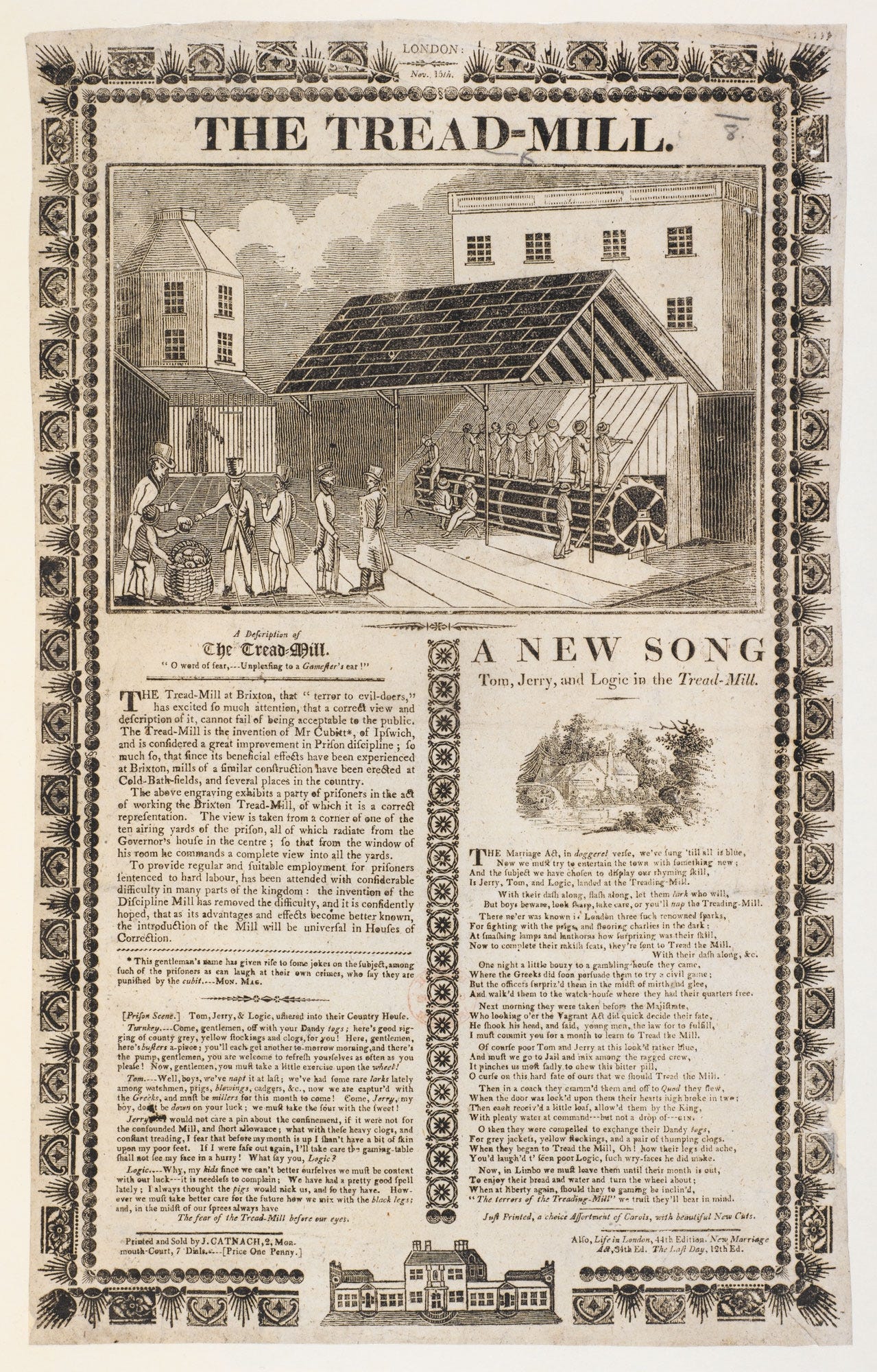
I’ve talked before about Brixton Gaol. It was started as a minimum security prison, and then went on to be notorious for introducing the treadmill to mill grain (see? that’s where the name comes from). Then they were pulled up at how inhumane it was that they were making prisoners walk 10 hours on the mill every day, which honestly IS horrifying.
It was then turned into a woman’s prison in the 1850s, and then in the 1880s, it briefly was a military prison. And then, it was turned into the remand prison for all of London.
This meant some of the most interesting people of the 20th century were lodged there. Savarkar, obviously. But also Bertrand Russell, who was there twice and said it was like an ‘ocean cruise’. And in the ‘60s, Mick Jagger was there on drug charges.
So, yeah, quiz question - connect Savarkar, Mick Jagger, and the treadmill.
There are many first-hand accounts of meeting Savarkar in Brixton Gaol. The one by Niranjan Pal (Nanu) talked about Savarkar being in good spirits, and they were literally talking about using techniques for escape that were straight out of the novels of Charles Dickens.
VVS Aiyar, one of Savarkar’s closest associates, though, writes about a more emotional meeting, where they try not to cry in front of the guards.
And David Garnett, who would eventually engineer a prison break for Savarkar (which then wouldn’t work), talks of the equanimity with which Savarkar faced his fate.
I try to combine all of these to both understand the evolution of Savarkar’s thought process from giving himself up willingly to be arrested to planning a prison break.
Brixton Gaol
Brixton Gaol’s damp, narrow hallways, imposing walls, and rigid routine felt strangely freeing to Tatya. There were bells to wake up to, line up for, and go to sleep after. The meals were prison food, but it was a remand facility; they weren’t too bad. Exercise time in the prison yard was energizing.
He still could wear his own clothes and could even get food from outside, so he didn’t feel reduced to a number just yet. And he got to read books from the prison library and write to his heart’s content.
A loud voice over the microphone announced the arrival of visitors. Tatya’s pulse quickened as he heard his name. He joined the procession to the visiting area, standing behind the bars of the partition, eyes scanning for familiar faces. Who had come with no fear of the attention of Scotland Yard?
As he was ushered into the visiting area, he saw Nanu and Dutt and waved at them.
“How are you doing?” Tatya asked.
“We’re … fine… we’re just…” Dutt said.
“What were you thinking, Tatyarao? Why did you come here?” Nanu snapped.
“I got tired of waiting for them to get me,” Tatya said.
“But you’re in jail now. And we don’t know what they’ll do to you.”
“Jail is fine! I can read books! I can write, and I’ve even gained a few pounds!”
“What if you end up hanged for sedition?”
“Juries in England rarely convict on sedition.”
“So you’ll be out in no time,” Nanu said, feeling his anxieties comforted.
“At worst, I’m looking at a couple of years. And I can still meet you all and write.”
“A rap on the knuckles,” Dutt said.
“We’ll break you out if you want us to,” Nanu said.
“We’ll find someone who looks just like you, dress him in your clothes, and swap you out when going to court. And then the replacement says, “I’m not Savarkar!” and he has to be let out by the law of the land.
“Sydney Carton and Charles Darnay?” Tatya smirked, “I, too, have read A Tale Of Two Cities.”
They all laughed.
“I’m so glad that harebrained scheme won’t be necessary,” Nanu said, “Outside, they are talking of you getting deported to India. Especially my father…”
“Old people worry too much,” Dutt added.
They did, Tatya thought.
