
Calculation Chariots, Brixton Gaol, Proteinmaxxing - Monday Cup Of Links #102
And Tagore, and morphine-laced potatoes.
Happy Monday!
Fall is here. The leaves are turning yellow. It’s starting to get colder, and I regret taking summer for granted already.
First, a novel update — I got some feedback, and I’m awaiting more. A lot of feedback is about the first 20 chapters, because that’s where people are at in their reading. It hit me hard that I need to make the first 20 chapters essentially perfect, and only then will people even bother to keep reading the rest. The clever callbacks and character arcs won’t matter unless there’s the promise of that in the first 20 chapters.
So that’s my focus now — Perfecting the first 20 chapters. It’s going to be a challenge to get back to writing, but maybe this round will be much easier.
Onto our links!
Savarkar’s Other Prison
We all know of Vinayak Savarkar’s time in the dreaded Cellular Jail in the Andamans. But, when he was arrested in London, he was lodged in Brixton Gaol. While trying to research what conditions were like there, I came across this brief history of Brixton Gaol.
It was first started as a minimum security prison for minor offenders — including a six-year-old! And then they introduced the treadmill. Back in the day, a treadmill was a literal mill - you treaded it so you could mill some grain. This was largely considered inhuman to force prisoners to run the treadmill for up to ten hours a day.
It was then turned into a woman’s prison in the 1850s, and then in the 1880s, it briefly was a military prison. And then, it was turned into the remand prison for all of London.
This meant some of the most interesting people of the 20th century were lodged there.
The article doesn’t mention Savarkar at all! But other notable figures include Bertrand Russell for two stints in the 1940s - he likened his experience to being on an ocean cruise, and Mick Jagger in 1967 who was arrested on drug charges.
Why was Rabindranath Tagore’s family so successful?
On Wednesday, I’ll be releasing an episode with a very interesting podcast guest!
In our conversation, Rabindranath Tagore, his upbringing, and his inspiration for Santiniketan came up. And I was reminded of this piece on Astral Codex Ten about what makes many people of the same family successful.
In that piece, Scott Alexander talks about many impressive families including the Curies, the Darwins, the Bohrs, the Poincares…. and the Tagores, who all had multiple members of the family, across generations, be successful.
At the end of the rather interesting piece, Mr. Alexander is no closer to understanding why the free-range childhood of the Tagores produced success just as the Tiger parenting of Marie Curie.
But it’s rather clear to me what the deal is - it’s just being surrounded by adults from whom you can learn interesting things. The more successful the adults around you, the more things you learn that are useful in your own success. It’s about building that connection more than how you build that connection or what you talk about. Kids learn by watching and doing more than listening to what you tell them to do.
So the Tagore children got that from being on their beautiful estate with lots of smart people visiting them, while Marie Curie gave that to her kids with concerted cultivation.
What do you think?
Do we need even more protein?
Apparently not! Apparently there’s no evidence to support that any more protein than 1.6 grams per kilogram of bodyweight has any additional positives. This guys says so.
I’m sharing this mainly because it agrees with my prejudice. I’ve long suspected that we need to eat more foods rich in vitamins, minerals and fiber to fix all our health issues rather than just plain protein.
That said, it feels like a lot of us don’t even get this much protein. And protein keeps you full, prevents you from snacking constantly, and a state of ketosis is great for autophagy… so I’m going to keep trying to increase my whole food protein intake, but not going to be resorting to supplements and such.
Magic Potatoes
I came across this article from the Washington Post from April 4, 1916.
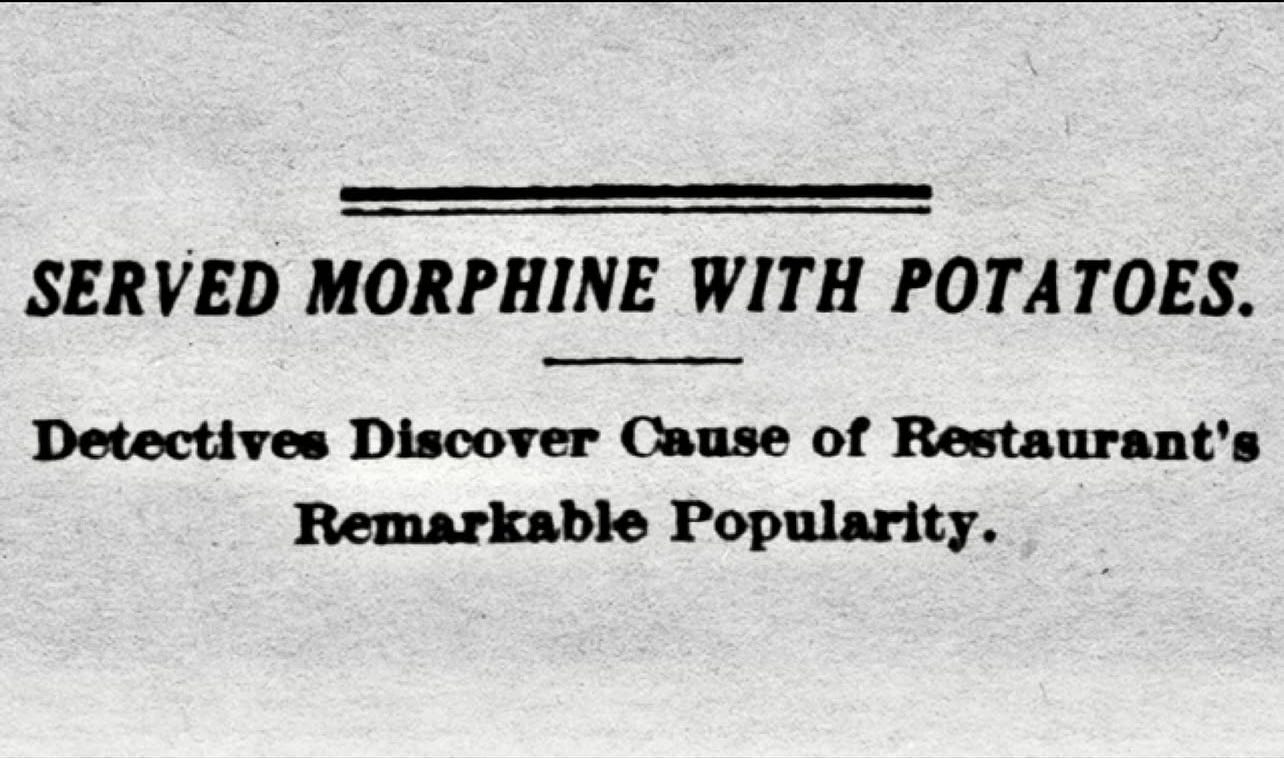
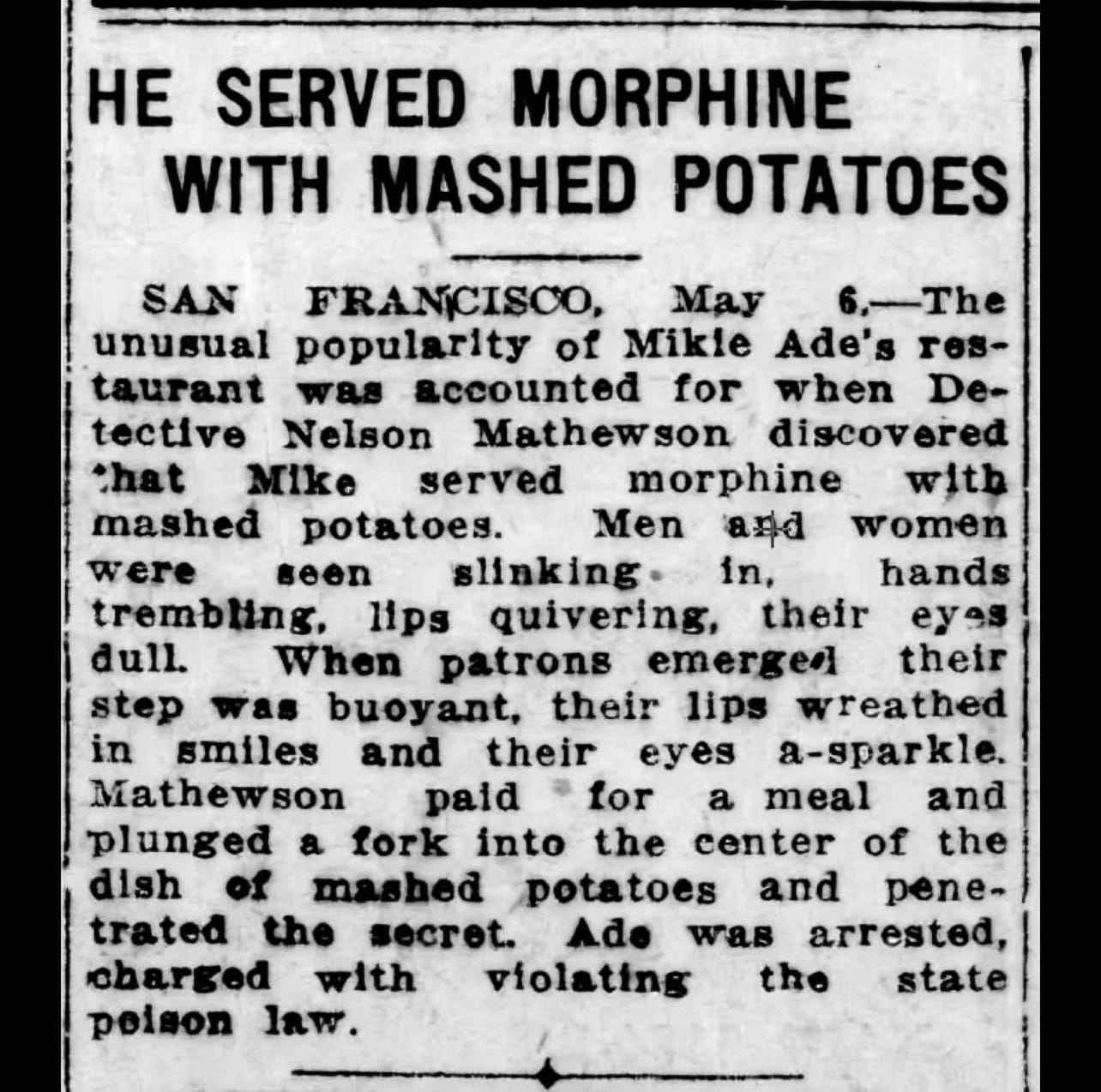
A San Francisco restauranteur thought the best way to make his restaurant popular was to mix morphine in the food.
There’s a literal episode of Futurama where this is the plot. Coincidence? I don’t think so — I’m sure the writers came across this and decided to add it to the plot.
Artifact - Chariot composed of calculations from Jain manuscript
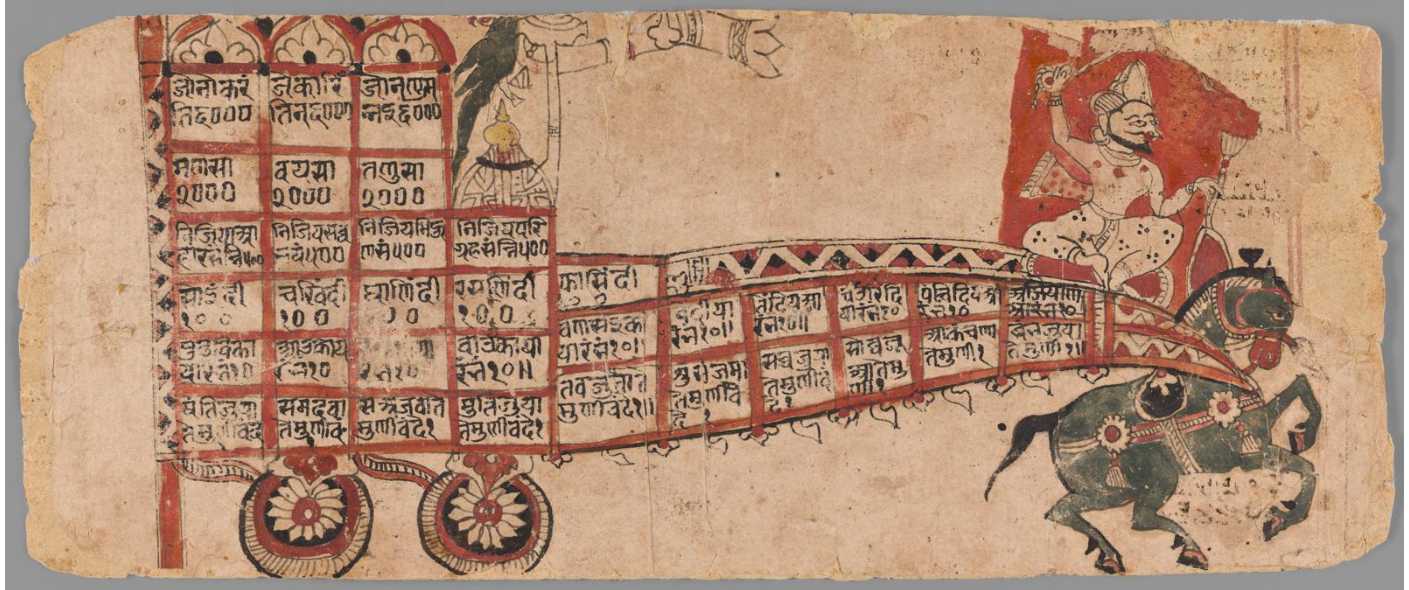
This is from a Jain manuscript from 1400-1450 Gujarat. It is now at the Asian Art Museum in San Francisco.
Some sources say this is a kind of horoscope calculation.
But I came across this Jain magazine that has a better perspective. [PDF]
An Illustrated Ardhamagadhi Dictionary by A C Woolner and Ratnachandraji identifies the above painting as 18000 Shilang Rath (Chariot with 18000 Jewels of Right Conduct (Charitra) for a Jain Monk), based on the Panchashak written by Haribhadra Suri.
Interesting.
Haribhadra Suri was a Brahmin scholar highly well versed in many languages with knowledge of Vedas and other scriptures. He was a great debater and had a lot of pride in his debating skills. He vowed that if he came across a shloka that he could not understand, he would become that person’s disciple. He came across a Sadhavi reciting a sutra from Acharya Jinbhadra’s (6th -7th century CE) Sanghrani that he could not understand, and hence he became a disciple of Acharya Jindatt (or Jinbhadra or Jinbhatt). Prabhavak Charitra and Prabhandh Kosh indicate Jinbhadra as the Guru of Haribhadra.2 He is known to compile about 1400-1440 granths, of which presently only 100 of them have been discovered. The 18000 Shilang Rath caters to the Right Conduct (Samyak Charitra), an essential requirement for the monks on the path towards Moksha or Salvation. Haribhadra gained this knowledge on the Samyak Charitra from Acharya Jinbhadra’s work Dhyan Shatak (Book on Meditation consisting of 105-106 couplets).
Couplet 60 of Dhyan Shatak by Acharya Jinbhadra … mentions how a Jain Monk can ride on a chariot consisting of Jewels of Right conduct and hastily travel the path towards Moksha or Salvation.
There’s a lot more detail in that magazine about what these numbers are, and how they add up to 18,000. I’m not sure I grasp all of it, and I’d love anyone giving me more context.
Eric's take on protein isn't that great, tbh.
In general, Eric Topol isn't known for great interpretation of scientific papers. He's had bad interpretations during Covid times and more recently even in GLP-1 debates. I'm not saying he's always wrong, but outside of his cardiology expertise, he more often misses than hits.
He's right in that higher protein intake isn't useful because it can't be stored. But if you're resistance training and want to maximize muscle gain, then the 2g/kg is the gold standard. He is cherry-picking the evidence to show what he wants to show. There are tons of high quality RCT studies showing the 2g/kg standard. And there's also evidence showing that more than 2g/kg doesn't help anyone.
Even for people into sports other than strength sports will see a hit in performance if protein decreases. This is just at amateur level, btw. I'm not even getting into the expert/elite levels.
That doesn't mean that you shouldn't focus on fruits and veggies and high fibre foods. Both are needed and it isn't an either/or.